The Lost Cause
I explore how brainwashing survives not only through institutions, but through family memory, emigration, and inherited pride via the lens of a film on propaganda in the background of a brutal war.

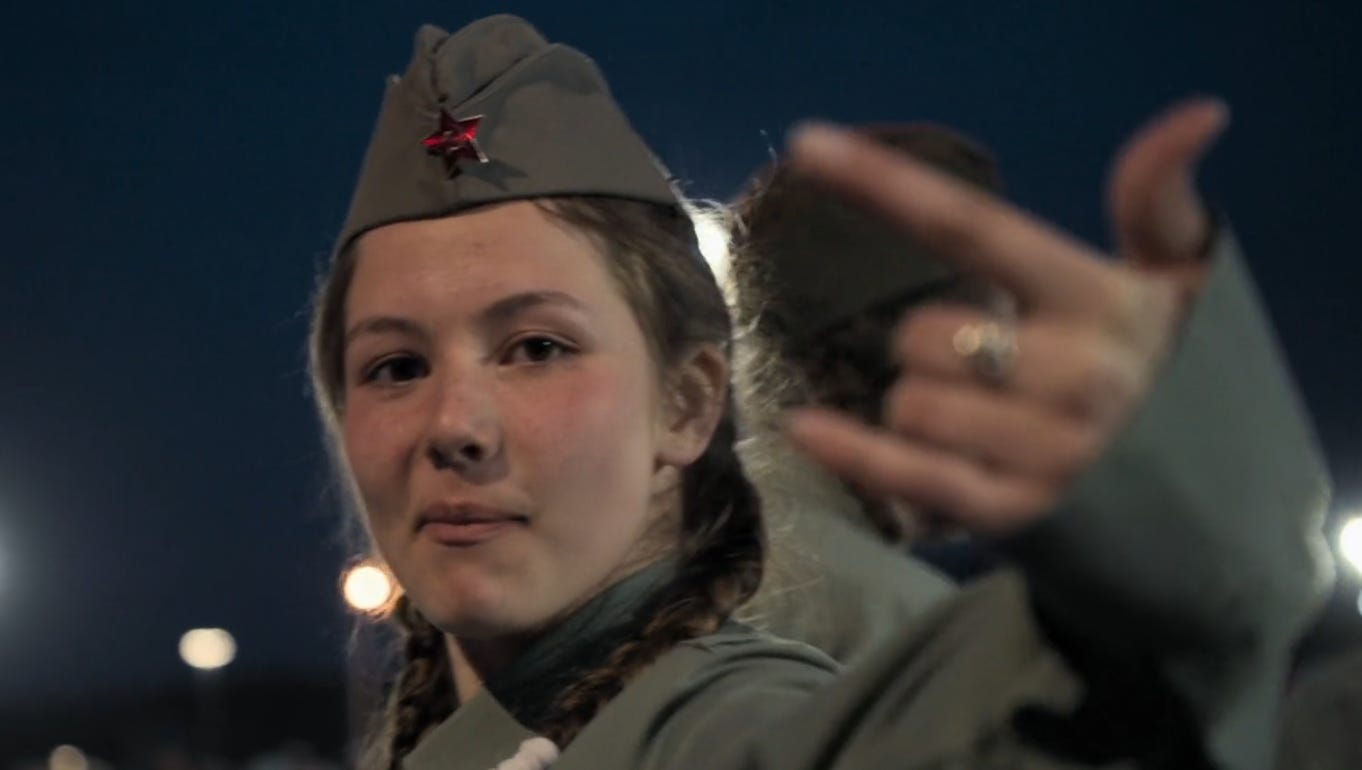
*A still from Mr.Nobody Vs.Putin
I am still torn over who is the more tragicomic figure in BAFTA award winning documentary Mr. Nobody vs. Putin: the protagonist Pavel, known as Pasha, or the history teacher Abdulmanov.
Pasha looks like the iconic Soviet film character Shurik come to life - the endearing, hapless, sexless, nerdy, pedantic antihero of Soviet comedy. Only he is slightly more pudgy, but equally looks like someone who is not feared, followed, or taken seriously. By contrast, Abdulmanov is like Koschei Bessmertny, the immortal skeleton, the central villain of most Russian folk tales. Tall, skinny and humourless, absolutely ideologically committed to the country’s politics. He is obedient to dictates from above, reverent toward the Soviet past, and unwaveringly loyal to the present leadership and its narrative. One cannot even call him an opportunist or a sycophant in the conventional sense. Yet he was rewarded with a new flat as the best teacher. Possibly he was one, he seemed very sincere. Earlier, he would have been a member of the Communist Party. In Putin’s Soviet Union v2.0 he is predictably a member of Yedinaya Rossiya (United Russia).
Pasha, like many nerdy, colourless and faceless members of modern Russian society, is deeply unhappy with the direction the country is taking. Yet he is utterly helpless in fighting a system that has already shut down the Gulag Museum in Moscow and has begun handing out gulag-like 15 to 25-year sentences for “discrediting the army,” spreading “fakes” about the military, or insulting the president. Many of those sentenced are not even as old as the prison terms awaiting them.
The real tragedies in the film lie elsewhere. There is the blackened screen accompanied by the soundtrack of the heart-wrenching cries of a mother at a young soldier’s funeral. There is the stony-faced Masha visiting her brother’s grave. He was conscripted and made to sign a contract for deployment to Ukraine. He deserted, was caught, and sent back to the front, where he was killed, possibly “obnulirovan,” a euphemism for being eliminated by one’s own side.
Then there is Pasha’s mother, a school librarian who looks long past retirement age, but likely remains in her job because no one else would work for the salary. She raised three children alone and lived through the Soviet collapse and the chaos of the 1990s, saw the relative stability of the 2000s and now watches the return of the wall, both literal and metaphorical. She looks tired, measured, and resigned, like someone who has seen the worst and expects nothing better. In the aftermath of the film, she was dismissed by the authorities. The first victim of the purge; more would invariably follow.
To mark the fourth year of Putin’s war, I decided to show the film to my mother. An avowed Russistka and a staunch “armchair” Stalinist who is equally proud of never stepping into the Komsomol (Communist Youth Organization). Whenever she started any tirade with a grandiose “In our Soviet Union...” after reaching adulthood, I always remind her, somewhat crudely, that she fled her country by marrying the first foreigner she met. Since emigrating in 1966 she has lived in a self-contained bubble of our family and four walls, venturing out mainly to the bazaar. She learned only the most rudimentary strands of the local language. Her English fared only slightly better. To date, she remains as committed as Abdulmanov in the film to the idea of the greatness of the Stalin era, the inability of her compatriots to do any wrong and the sanctity of her homeland.
At times her worldview is peculiar, if not outright bizarre; or maybe it isn’t that strange at all. Just a simple case of “Sovdek programming” (or what I call “brain stamping”) constantly clashing with her identity as an emigrant. She would ponder, nod wisely to herself and say something completely outlandish like, “Stalin was such a great humanitarian leader because he first studied in a religious seminary.” And she would be dead serious. Solzhenitsyn, in her view, was an ungrateful traitor whose cancer was cured by the Gulag doctors, where he should have been instead left to die. His real unspoken fault though, was that he exposed the Gulag jail system to the world. She hates Khrushchev, whom she belittles as a goose herder, not because of his brutal post-WW2 repressions in Ukraine but for destroying Stalin’s personality cult. Andrei Sakharov was just plain creepy for being a dissident and was probably a closet Zionist. She insists her lineage traces back to Veliky Novgorod, not to “those Tatar converts of Moscow,” and she still carries the ingrained pride of someone from the cultural capital: Leningrad. Meanwhile, nearly every other Jewish person I met felt compelled to ask whether I was Jewish. So much for my Beloya Koste (white bone) of Slavic ancestry.
She was always interested in global affairs, and her worldview was shaped by diligently reading English newspapers, till her eyesight permitted it, but very often misunderstood facts due to her limited vocabulary. Yet she never bothered to clarify unfamiliar words and drew firm, brazen, and at times opposite conclusions with absolute confidence. In my experience, the adage that “my wife knows everything, and whatever she doesn’t, her mother knows for sure” originated among the Slavic groups and reached its gold standard among Russians, especially Soviet-era women. With my mother, it is the same gold standard, but on steroids.
My personal grievance, one I never forgive, is that as an extremely naive child, my early years were shaped by what can only be described as a binary star system of all-knowing, castrating and narcissistic parenting. So their unquestionable intellectual prowess was rubbed in since I was in nappies, which made me swallow anything she said - hook, line, and sinker. And with my inherited outspokenness, I often repeated her deductions publicly. The embarrassment that often followed was predictable, and I was left red-faced more times than I would care to remember.
Now as an adult the only thing I agree with my mother on, whom fate has ordained me to be the sole caregiver of, is our shared love for Chekhov. Whenever Russian friends or relatives called or messaged inquiring about my well-being, that was until they kept in touch, my standard reply was a take on Remarque : “Na Vostochnom Fronte bez peremen” (No changes on the eastern front).
Russians and patriotism have a long and convoluted history, invariably tangled with suffering, endurance, submission, and very often death. It is perhaps best condensed in one anecdotal yet brutal phrase: “Babi eshchyo narozhayut” (Women will give birth to more). The saying allegedly dates back to the Battle of Narva in the 1700s, as how a young Tsar Peter was consoled after suffering heavy losses in battle against Sweden.
Victorian era British writer James Holman, a naval officer who later lost his eyesight and became known as the blind travel writer, who even sailed across the world with Charles Darwin. He travelled across Tsarist Russia as far as Irkutsk in Siberia until he was booted out as a spy. In his memoir, he wrote about terrible roads, the all-pervading corruption, lamented the poverty and wretchedness of the peasantry and serfs, equally marvelling at the latter’s devout patriotism toward the Tsar and country.
More recently, in the early 2000s, the famous Russian satirist and TV personality Mikhail Zhvanetsky retold how someone told him: “Mikhailich, there is this all-encompassing darkness here. Russians would starve, but their country should be great. Wouldn’t it make more sense for everyone to be well-fed, and that would make our country great? But no. Here they would starve, but their country should be great.”
In an interview last week the former jailed Russian oligarch Mikhail Khodorkovsky was asked about the Russian émigré population’s view on the Ukraine war. He said that half of them cheer that “Putin will show them!” When asked why, he replied, “Probably to compensate for their own lack of status and peronal life failures abroad.”
The emigrant’s compulsive need to defend the homeland, no matter how abhorrent or absurd its actions, or to bask in its historical and mythical glory, is not uniquely Russian. As Indians, we endure the tedium of our emigrants in the West, the so-called NRIs, lecturing us on patriotism, nationalism, Sanatan Dharma, caste purity, and the greatness of Modi. They equally force their poor children to attend Sanskrit classes and Bharatanatyam lessons, lest they forget their roots. One Indian born and brought up in England had the audacity, or the delusion, to tell me that he was a “holy Brahmin.”
Coming back to my mother. She gets her daily dose of Russia’s version of truth, from Russian TV channels, which she now watches on a tablet. I make it a point to make her occasionally watch the banned in Russia, TV Channel Dozd, Radio Liberty or BBC Russian Service programs. Not knowing how to flip YouTube channels, she endures them with the face of someone swallowing a toad.
When I showed her the documentary film “Russians at War” by Russian filmmaker Anastasia Trofimova, who unofficially embedded herself in a Russian Army battalion fighting in Ukraine, she declared midway that she wanted to go to sleep. Watching how a wounded Russian soldier is blown to pieces by a grenade dropped by a drone or listening to Russian kontraktniki discuss what on earth they are fighting for, and finally learning that only 300 of their original 900 remained alive, diverged from her idea of Russia’s righteous position and victory in Ukraine.
“What are you hoping to achieve?” my sister asks from across the country on the phone. “She will never change, you only raise your BP.”
“No, she will not,” I conceded and laughed. I told her I saw myself as an inquisitor handing a long cross to the person about to be burned at the stake, saying, “Repent, my child!” It is part payback for the Sovdek rubbish she spouted, which I parroted like a gullible idiot when young. But more of an attempt to make her feel some compassion for the pain and losses on both sides, caused by the very force she regards as above questioning. And to make her realise at least in the remaining years of her life, that her take on life and history has always been brutally flawed.
After finishing Mr. Nobody vs. Putin, she had just one observation - for a schoolteacher, he used too many matershiniye (profanities) words.
Mrs. Abdulmanova had spoken.
A lost cause indeed.
Never heard such real state of affairs of the Soviet Union and Putin's Russia laid bare in very eloquent and your uncharitable style. Am amazed that your mother hailing from USSR still carries the pangs of pain and ideology that doesn't seem to erase from her memory. Call it dogmatic or pogrom the origins remain firmly embedded despite years of staying away from the actual 'theater.' Recently, on the other side, Ukraine, I heard about a close relative's sister in law's life lived in the pall of drone's sweeping in and battering neighbouring blocks; the manner as if they'd be the next target. Their recent family picture says beyond thousand words; about fears, uncertainties and life in constant turmoil whereas people in the neighbouring country peacefully carry themselves as if business is as usual. But one look at the lady's face and the pangs of fear jump to reveal the dread of bombing reality, all around!
So your epic recount of the era bygone with present trying to peek in, is indeed wonderfully readable and insightful. Thanks Ravi!!